Thursday, May 20, 2010

Lane Snapper


Family Lutjanidae, SNAPPERS Lutjanus synagris

Description: color silvery-pink to reddish with short, irregular pink and yellow lines on its sides; diffuse black spot, about as large as the eye; the dorsal fin centered above the lateral line; outer margin of caudal fin blackish.

Similar Fish: mutton snapper, L. analis (anal fin rounded in lane snapper, pointed in mutton).

Where found: juveniles INSHORE over grass beds or shallow reefs; adults OFFSHORE; most common in south Florida.

Size: usually less than 1 pound.


*Florida Record: 6 lbs., 6 ozs.

Remarks: spawns March through September; sexually mature at 6 inches; feeds on bottom, taking crustaceans, mollusks, and fish.

* The Florida records quoted are from the Department of Environmental Protection's printed publication, Fishing Lines and are not necessarily the most current ones. The records are provided as only as a benchmark.

Mangrove Snapper


Family Lutjanidae, SNAPPERS Lutjanus griseus

Description: color dark brown or gray with reddish or orange spots in rows along the sides; dark horizontal band from snout through eye (young only); two conspicuous canine teeth at front of upper jaw; dorsal fins have dark or reddish borders; no dark spot on side underneath dorsal fin.

Similar Fish: cubera snapper, L. cyanopterus.

Where found: juveniles INSHORE in tidal creeks, mangroves, and grass beds; adults generally NEARSHORE or OFFSHORE on coral or rocky reefs.

Size: offshore catches common 8 to 10 pounds.


*Florida Record: 16 lbs., 8 ozs.

Remarks: spawns June through August; feeds on crustaceans and small fish.

* The Florida records quoted are from the Department of Environmental Protection's printed publication, Fishing Lines and are not necessarily the most current ones. The records are provided as only as a benchmark.

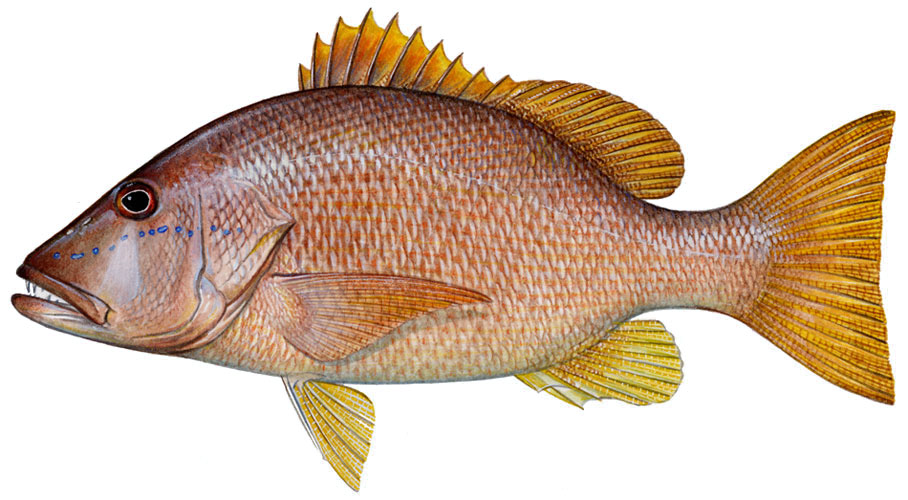
Dog Snapper


Family Lutjanidae, SNAPPERS Lutjanus jocu

Description: color brown with a bronze tinge, lighter on sides; canine teeth very sharp, one pair notably enlarged, visible even when mouth is closed; in adults, pale triangle and a light blue interrupted line below the eye; no dark spot on body underneath dorsal fin.

Similar Fish: schoolmaster, L. apodus (no white triangle under eye and fins are more yellow); other snappers.

Where found: large adults OFFSHORE over coral and rocky reefs; juveniles associated with estuaries.

Size: large snapper, attaining 30 pounds.


*Florida Record: n/a

Remarks: spawns from spring through fall; known as night feeder; taking fishes, mollusks, and crustaceans.

* The Florida records quoted are from the Department of Environmental Protection's printed publication, Fishing Lines and are not necessarily the most current ones. The records are provided as only as a benchmark.

Cubera Snapper


Family Lutjanidae, SNAPPERS Lutjanus cyanopterus

Description: color dark brown or gray, may have a reddish tinge; broad-based triangular tooth patch on roof of mouth with a posterior extension; despite its specific name, which translates to "blue-fin," the fins have only a slight tinge of blue; canine teeth in both jaws very strong; one pair of canines enlarged and visible even when mouth is closed.

Similar Fish: gray snapper.

Where found: juveniles INSHORE in grass beds; adults OFFSHORE or NEARSHORE over wrecks, reefs, and ledges.

Size: common to 40 pounds.


*Florida Record: 116 lbs.

Remarks: the largest of the snappers, ranging to 125 pounds; not common anywhere in its range; feeds on fishes and larger crustaceans; in the Keys, spawns during later summer.

* The Florida records quoted are from the Department of Environmental Protection's printed publication, Fishing Lines and are not necessarily the most current ones. The records are provided as only as a benchmark.

Blackfin Snapper


Family Lutjanidae, SNAPPERS Lutjanus buccanella

Description: color generally red, with yellowish caudal, anal, and pelvic fins; distinctive and prominent dark comma-shaped blotch at the base of the pectoral fins, which gives the fish its common name; anal fin rounded; no black spot on side underneath dorsal fin.

Similar Fish: other snappers.

Where found: adults OFFSHORE near continental shelf.

Size: common to 20 inches, larger adults seeking deeper waters.


*Florida Record: n/a

Remarks: sometimes marketed as red snapper; feeds on smaller fishes.

* The Florida records quoted are from the Department of Environmental Protection's printed publication, Fishing Lines and are not necessarily the most current ones. The records are provided as only as a benchmark.


Southern Stingray


Identification: Color brownish dorsally and whitish ventrally. Disc broad angular (rhomboid) with pointed corners. Snout moderate, not protrusive. Spine near base of long whip like tail. Well developed ventral fin fold on tail, dark brown to black in color. Dorsal fin fold on tail absent.
Habitat: Inhabits coastal waters including ocean beaches, bays, estuaries, and river mouths. Generally found near shore on grass and sand/mud flats but does venture into deeper coastal waters up to ~200 feet.
Feeding: Benthic feeder. Feeds mainly on bivalves and marine worms and also takes shrimp, crabs, and small fishes.
Reproduction: Aplacental viviparity. Up to seven pups per litter.
Size/Age: Wingspan of 4-5 feet and weigh up to around 200 pounds.
Human Factors: Observed singly, in pairs, and in aggregations. Non-aggressive species of little danger to humans with the exception of their defensive venomous barb located near the base of the tail. Avoid handling or exercise extreme caution. Do the “Stingray shuffle”.

Shortfin Mako


Family Lamnidae, MACKEREL SHARKS Isurus oxyrinchus

Description: lunate tail with similarily sized lobes; lateral keel at the base of the tail; deep blue back and white underside; underside of sharply pointed snout white; origin of first dorsal entirely behind base of pectoral fins; second dorsal fin slightly in front of anal fin; slender, recurved teeth with smooth edge.
Similar Fish: white shark, Carcharoden carcharias; longfin mako, Isurus paucus.
Where found: OFFSHORE fish often seen near the surface.
Size: commonly 6 to 8 feet (200 to 300 pounds).
*Florida Record: 911 lbs, 12 ozs.
Remarks: active, strong swimming fish known for leaping out of the water when hooked; feeds on mackerel, tuna, sardines, and some much larger fish.
* The Florida records quoted are from the Department of Environmental Protection's printed publication, Fishing Lines and are not necessarily the most current ones. The records are provided as only as a benchmark.