skip to main |
skip to sidebar
 Family Lutjanidae, SNAPPERS Lutjanus griseus
Description: color dark brown or gray with reddish or orange spots in rows along the sides; dark horizontal band from snout through eye (young only); two conspicuous canine teeth at front of upper jaw; dorsal fins have dark or reddish borders; no dark spot on side underneath dorsal fin.
Similar Fish: cubera snapper, L. cyanopterus.
Where found: juveniles INSHORE in tidal creeks, mangroves, and grass beds; adults generally NEARSHORE or OFFSHORE on coral or rocky reefs.
Size: offshore catches common 8 to 10 pounds.
*Florida Record: 16 lbs., 8 ozs.
Remarks: spawns June through August; feeds on crustaceans and small fish.
* The Florida records quoted are from the Department of Environmental Protection's printed publication, Fishing Lines and are not necessarily the most current ones. The records are provided as only as a benchmark.
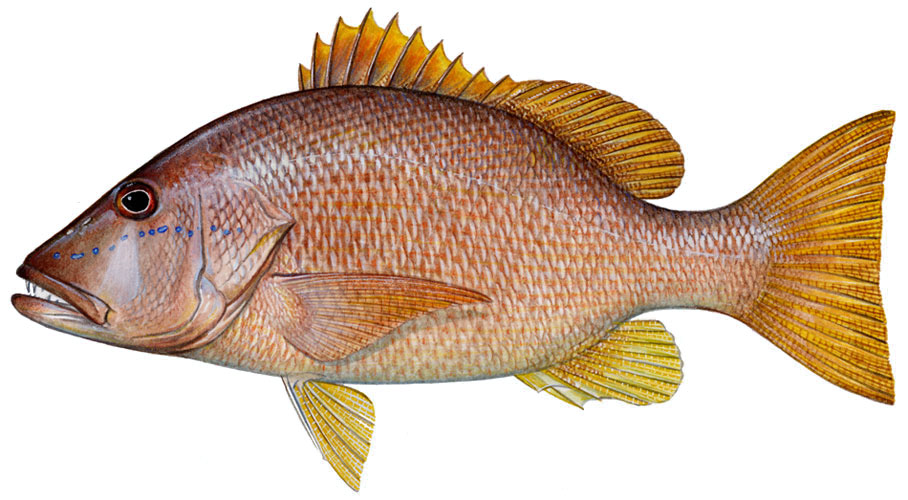
 Family Lutjanidae, SNAPPERS Lutjanus jocu
Description: color brown with a bronze tinge, lighter on sides; canine teeth very sharp, one pair notably enlarged, visible even when mouth is closed; in adults, pale triangle and a light blue interrupted line below the eye; no dark spot on body underneath dorsal fin.
Similar Fish: schoolmaster, L. apodus (no white triangle under eye and fins are more yellow); other snappers.
Where found: large adults OFFSHORE over coral and rocky reefs; juveniles associated with estuaries.
Size: large snapper, attaining 30 pounds.
*Florida Record: n/a
Remarks: spawns from spring through fall; known as night feeder; taking fishes, mollusks, and crustaceans.
* The Florida records quoted are from the Department of Environmental Protection's printed publication, Fishing Lines and are not necessarily the most current ones. The records are provided as only as a benchmark.
 Family Carangidae, JACKS and POMPANOS Trachinotus goodei
Description: grayish-blue-green on top of head and along the back; bright silvery sides; yellow on breast; elongated dorsal and anal fins; dusky or black with bluish edges; deep body, with four narrow bars high on the sides, and traces of a fifth fin nearer the tail; no scutes.
Similar Fish: pompano, T. carolinus; permit, T. falcatus.
Where found: in clear water along sandy beaches and bays, occasionally found over reefs; most common in south Florida.
Size: rarely over 1 pound, reported to 3 pounds.
*Florida Record: n/a
Remarks: thought to spawn OFFSHORE in spring, summer, and fall; has shown rapid growth in mariculture experiments; readily strikes small artificial lures.
* The Florida records quoted are from the Department of Environmental Protection's printed publication, Fishing Lines and are not necessarily the most current ones. The records are provided as only as a benchmark.
 Family Scombridae, MACKERELS and TUNAS Scomberomorous regalis
Description: color of back iridescent bluish green; sides silvery, yellow spots forming lines above and below a bronze stripe from pectoral fin to base of tail; front of first dorsal fin is bluish black; lateral line curves gradually to base of caudal fin.
Similar Fish: Spanish mackerel, S. maculatus; king mackerel, S. cavalla (only the cero has the yellow-brown stripes from the pectoral to caudal fin).
Where found: NEARSHORE and OFFSHORE fish occurring mainly in south Florida, especially over coral reefs and wrecks.
Size: common to 5 pounds.
*Florida Record: 15 lbs., 8 ozs.
Remarks: unlike other mackerels, does not stray far from south Florida waters; spawns OFFSHORE in midsummer; feeds on small fish and squid.
* The Florida records quoted are from the Department of Environmental Protection's printed publication, Fishing Lines and are not necessarily the most current ones. The records are provided as only as a benchmark.