Showing posts with label estuaries. Show all posts

Thursday, May 20, 2010

Ladyfish


Family Elopidae, TARPONS Elops saurus

Description: terminal mouth, slender body, small scales; last dorsal ray not elongated; head small and pointed.
Similar Fish: juvenile tarpon, Megalops atlanticus.
Where found: INSHORE fish, in bays and estuaries; occasionally enters freshwater, occurring in tidal pools and canals; often forms large schools and harasses bait at the surface.
Size: 2 to 3 pounds.
*Florida Record: 4 lbs., 10 ozs.
Remarks: known to spawn OFFSHORE, ribbon-like larvae very similar to Albula and Megalops, peaking in fall; adult feeds predominantly on fish and crustaceans; leaps when hooked.
* The Florida records quoted are from the Department of Environmental Protection's printed publication, Fishing Lines and are not necessarily the most current ones. The records are provided as only as a benchmark.

Swordspine Snook


Family Centropomidae, SNOOKS Centropomus ensiferus

Description: smallest of the snooks; profile slightly concave; prominent lateral line outlined in black (not solid), extends through caudal fin; color yellow-green to brown-green above, silvery below; giant second anal spine, hence the name; largest scales of all snook.
Similar Fish: other Centropomus.
Where found: occurs in INSHORE estuarine habitats from south Florida to as far north on east coast as St. Lucie River.
Size: usually less than 1 pound (12 inches).
*Florida Record: n/a
Remarks: full-grown adults are less than 12 inches long; mangrove shoreline habitat serves as nursery area for young; rare on Florida's west coast; prefers only slightly brackish or fresh water.
* The Florida records quoted are from the Department of Environmental Protection's printed publication, Fishing Lines and are not necessarily the most current ones. The records are provided as only as a benchmark.
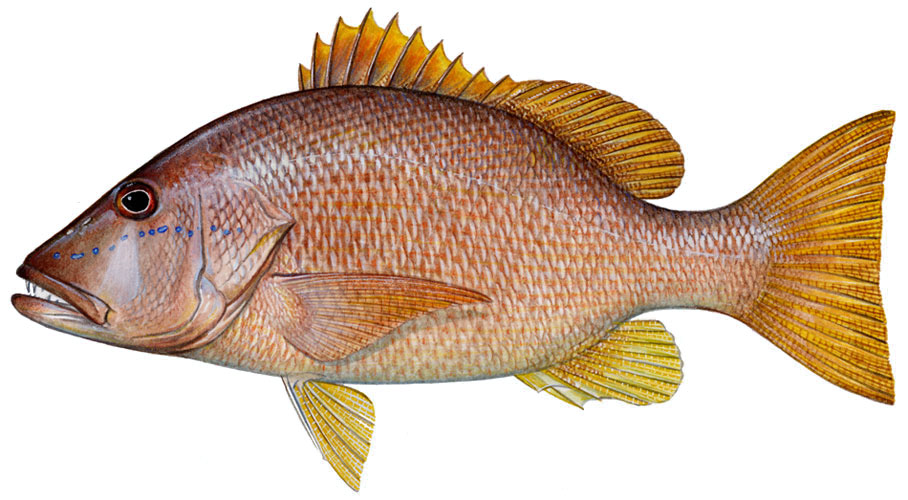
Dog Snapper


Family Lutjanidae, SNAPPERS Lutjanus jocu

Description: color brown with a bronze tinge, lighter on sides; canine teeth very sharp, one pair notably enlarged, visible even when mouth is closed; in adults, pale triangle and a light blue interrupted line below the eye; no dark spot on body underneath dorsal fin.

Similar Fish: schoolmaster, L. apodus (no white triangle under eye and fins are more yellow); other snappers.

Where found: large adults OFFSHORE over coral and rocky reefs; juveniles associated with estuaries.

Size: large snapper, attaining 30 pounds.


*Florida Record: n/a

Remarks: spawns from spring through fall; known as night feeder; taking fishes, mollusks, and crustaceans.

* The Florida records quoted are from the Department of Environmental Protection's printed publication, Fishing Lines and are not necessarily the most current ones. The records are provided as only as a benchmark.

Southern Stingray


Identification: Color brownish dorsally and whitish ventrally. Disc broad angular (rhomboid) with pointed corners. Snout moderate, not protrusive. Spine near base of long whip like tail. Well developed ventral fin fold on tail, dark brown to black in color. Dorsal fin fold on tail absent.
Habitat: Inhabits coastal waters including ocean beaches, bays, estuaries, and river mouths. Generally found near shore on grass and sand/mud flats but does venture into deeper coastal waters up to ~200 feet.
Feeding: Benthic feeder. Feeds mainly on bivalves and marine worms and also takes shrimp, crabs, and small fishes.
Reproduction: Aplacental viviparity. Up to seven pups per litter.
Size/Age: Wingspan of 4-5 feet and weigh up to around 200 pounds.
Human Factors: Observed singly, in pairs, and in aggregations. Non-aggressive species of little danger to humans with the exception of their defensive venomous barb located near the base of the tail. Avoid handling or exercise extreme caution. Do the “Stingray shuffle”.

Blacktip Shark

Family Carcharhinidae

Habitat: Common in Florida’s coastal waters, bays and estuaries. A very active, fast-swimming shark often seen at the surface. Often forms large schools during annual migration times. Migrates southward and into deeper coastal waters during winter months. May leap out of the water and, like the related spinner shark, spin around several times before dropping back into the sea.

Feeding: Feeds primarily on fishes but also eat small sharks, some rays and skates, squid, crabs, octopus, and lobster.

Reproduction: Gives birth to live young. Litters contain 1–10 pups. Females swim into shallow bays in spring and early summer to give birth. Size at birth 22–28 inches.

Size/Age: Maximum length about 6 feet. Matures at approximately 6–7 years of age(about 5 feet) and is estimated to live 10 + years.

Human factors: Valuable commercial species with marketable flesh, hide, fins, and liver. One of the most commonly collected sharks in the commercial fishery. Fished for sport on light tackle and often leap out of the water when hooked. Has been implicated in attacks on bathers.

Bonnethead Shark


Family Sphyrnidae, HAMMERHEAD SHARKS Sphyrna tiburo

Description: broadly widened head in the shape of a shovel; only slight indentation of anal fin; front of head not notched at midline; gray or grayish-brown in color.

Similar Fish: other hammerhead sharks.

Where found: INSHORE species found in bays and estuaries.

Size: commonly 3 to 4 feet.


*Florida Record: n/a

Remarks: matures at about 3 feet in length and bears 6 to 12 young at one time; feeds chiefly on crabs and other crustaceans.

* The Florida records quoted are from the Department of Environmental Protection's printed publication, Fishing Lines and are not necessarily the most current ones. The records are provided as only as a benchmark.

Atlantic Sharpnose Shark


Family Carcharhinidae, REQUIEM SHARKS Rhizoprionodon terraenovae

Description: long and flattened snout; white trailing edge of pectoral; black-edged dorsal and caudal fins, especially when young; may have small whitish spots on sides; furrows in lips at the corners of the mouth; outer margin of teeth notched; second dorsal fin originates over middle of anal fin; brown to olive-gray in color with white underside; slender body.

Similar Fish: other carcharhinids.

Where found: INSHORE species, even found in surf; also common in bays and estuaries; adults occur OFFSHORE.

Size: small species, 2 to 4 feet.


*Florida Record: n/a

Remarks: mature adults between 2 and 2.75 feet long; 4-7 newborns range from 9 to 14 inches in length; adults feed on small fish and crustaceans.

* The Florida records quoted are from the Department of Environmental Protection's printed publication, Fishing Lines and are not necessarily the most current ones. The records are provided as only as a benchmark.

Goliath Grouper


Family Serranidae, SEA BASSES AND GROUPER Epinephelus itajara

Description: head and fins covered with small black spots; irregular dark and vertical bars present on the sides of body; pectoral and caudal fins rounded; first dorsal fin shorter than and not separated from second dorsal; adults huge, up to 800 pounds; eyes small.

Similar Fish: other grouper.

Where found: NEARSHORE often around docks, in deep holes, and on ledges; young often occur in estuaries, especially around oyster bars; more abundant in southern Florida than in northern waters.

Size: largest of the groupers.


*Florida Record: 680 lbs.

Remarks: spawns over summer months; lifespan of 30 to 50 years; feeds on crustaceans and fish. NOTE: jewfish are totally protected from harvest in Florida waters.

* The Florida records quoted are from the Department of Environmental Protection's printed publication, Fishing Lines and are not necessarily the most current ones. The records are provided as only as a benchmark.

Wednesday, May 19, 2010

Weakfish


Family Sciaenidae, DRUMS Cynoscion regalis

Description: dark olive or blue-green back; sides covered in tones of blue, purple, lavender, gold and copper; irregular diagonal rows of vaguely-defined dark spots appear above the lateral line; 1 to 2 prominent canine teeth usually present at tip of upper jaw; black margin on tip of the tongue; pelvic and anal fins yellow; pectoral fins olive on outside, yellow underneath; mouth yellow inside.
Similar Fish: other seatrouts.
Where found: an Atlantic coast fish, possibly found in the extreme southeastern Gulf; adults move INSHORE and north during warm months inhabiting the surf, inlets, bays, channels and estuaries; adults move OFFSHORE and south during cold months; juveniles inhabit estuaries which serve as nurseries.
Size: 2 to 3 pounds.
*Florida Record: 10 lbs.
Remarks: may mature as early as age 1; spawns in NEARSHORE or estuarine areas between April and October; schooling fish; feeds primarily on shrimp and fish.
* The Florida records quoted are from the Department of Environmental Protection's printed publication, Fishing Lines and are not necessarily the most current ones. The records are provided as only as a benchmark.

Atlantic Croaker


Family Sciaenidae, DRUMS Micropogonias undulatus

Description: inferior mouth; 3 to 5 pairs of small barbels on chin; silver-gray or bronze body with dark oblique wavy bars or lines; iridescent especially on head; preopercle strongly serrated.
Similar Fish: spot, Leiostomus xanthurus (has no chin barbels and has a dark blotch on shoulder).
Where found: generally found north of Tampa Bay on the west coast and north of Cape Canaveral on the east coast; young fish found in estuaries; older fish (2 to 3 years) inhabit deep OFFSHORE waters during the winter months and move into bays and estuaries during the spring, summer and fall.
Size: usually less than 2 pounds.
*Florida Record: n/a
Remarks: during spawning becomes bronze or yellow in color; spawning apparently occurs OFFSHORE in fall; longevity 2 to 4 years.
* The Florida records quoted are from the Department of Environmental Protection's printed publication, Fishing Lines and are not necessarily the most current ones. The records are provided as only as a benchmark.