Showing posts with label offshore. Show all posts

Thursday, May 20, 2010

Yellowfin Tuna

Family Scombridae

Description: pectoral fin moderately long, reaching point below beginning of second dorsal fin; second dorsal fin and all finlets yellow; no white rear edge on caudal fin; golden stripe on side; second dorsal and anal fins become much longer with age (to about 1/5 of total length); eye small; 26 to 35 gill rakers

Size: to 2.1 meters (82 inches) and 176 kilograms (367 pounds)

Where found: offshore mostly bluewater; in or near the Gulfstream

Wahoo

Family Scombridae

Description: body slender; elongate jaws form a pointed beak; dark bluish above, with about 30 dark bars; whitish below first dorsal fin long and low, with 21 to 27 spines; no gill rakes

Size: to 2.1 meters (83 inches) and 83 kilograms (183 pounds)

Where found: offshore Gulfstream; bluewater

Remarks: an important game fish, renowned for its tremendous runs and shifts of direction; usually not in schools; caught by trolling bait and artificial lures on flatlines

Little Tunny

Family Scombridae

Territory: Common offshore

Size: 20-25 lbs but usually caught 5-10 lbs

Remarks: An excellent baitfish for marlin and other large game fish, poor table fare

Blackfin Tuna


Family Scombridae
Description: pectoral fin moderately long, reaching point below beginning of second dorsal fin; second dorsal fin dusky; all finlets dusky, with white edges; dorsal finlets sometimes turn yellowish at base after death; a broad, brownish stripe along upper part of side; eye large; 19 to 25 gill rakers (usually 21 to 23) on first arch
Size: to 1 meter (3.25 feet) and 19 kilograms (42 pounds)
Where found: near shore and offshore

Tarpon


Family Elopidae, TARPONS Megalops atlanticus

Description: last ray of dorsal fin extended into long filament; one dorsal fin; back dark blue to green or greenish black, shading into bright silver on the sides; may be brownish gold in estuarien waters; huge scales; mouth large and points upward.

Similar Fish: (as juveniles) ladyfish, Elops saurus.

Where found: primarily INSHORE fish, although adult fish spawn OFFSHORE where the ribbon-like larval stage of the fish can be found.

Size: most angler catchs 40 to 50 pounds.


*Florida Record: 243 lbs.

Remarks: slow grower; matures at 7 to 13 years of age; spawning occurs between May and September; female may lay more than 12 million eggs; can tolerate wide range of salinity; juveniles commonly found in fresh water; can breathe air at surface; feeds mainly on fish and large crustaceans.

* The Florida records quoted are from the Department of Environmental Protection's printed publication, Fishing Lines and are not necessarily the most current ones. The records are provided as only as a benchmark.


Swordfish


Family Xiphiidae, SWORDFISHES Xiphias gladius

Description: color of back variable, black, greyish blue, brown, metallic purple, or bronze; sides dusky; underbelly dirty white; long, flat, sword-like upper jaw; lacks scales, teeth, and pelvic fins; single keel on each side of body in front of tail; first dorsal fin high, rigid and short; large eyes.
Similar Fish: no close resemblance to other billfishes.
Where found: OFFSHORE species worldwide in temperate and tropic waters; known to frequent depths of 400 to 500 fathoms; also has been seen basking at the surface.
Size: once averaged 200 pounds but overharvest has reduced size of commercially caught swordfish to average of 48 inches.
*Florida Record: 612 lbs., 12 ozs.
Remarks: large swordfish are all females, males seldom exceeding 200 pounds; except when spawning, females believed to prefer water cooler than that favored by males; feeds on squid, octopus, and pelagic fishes of all kinds.
* The Florida records quoted are from the Department of Environmental Protection's printed publication, Fishing Lines and are not necessarily the most current ones. The records are provided as only as a benchmark.

Yellowtail Snapper


Family Lutjanidae, SNAPPERS Ocyurus chrysurus

Description: back and upper sides olive to bluish with yellow spots; lower sides and belly with alternating narrow, longitudinal pink and yellow stripes; prominent midlateral yellow stripe begins at mouth and runs to tail, broadening as it passes the dorsal fins; caudal fin yellow and deeply forked; no dark lateral spot.

Similar Fish: none.

Where found: juveniles INSHORE on grassbeds and back reefs; adults NEARSHORE or OFFSHORE over sandy areas near reefs.

Size: common to 3 pounds.


*Florida Record: 7 lbs., 5 ozs.

Remarks: found mainly in tropical waters; spawns in midsummer; rarely exceeds 30 inches and 5 pounds in size; feeds on small fish and invertebrates.

* The Florida records quoted are from the Department of Environmental Protection's printed publication, Fishing Lines and are not necessarily the most current ones. The records are provided as only as a benchmark.

Vermilion Snapper


Family Lutjanidae, SNAPPERS Rhomboplites aurorubens

Description: color of entire body reddish, with a series of short, irregular lines on its sides, diagonal blue lines formed by spots on the scales above the lateral line; sometimes with yellow streaks below the lateral line; large canine teeth absent; orientation of mouth and eye give it the appearance of looking upward; no dark lateral spot.

Similar Fish: red snapper, L. campechanus (anal fin of red snapper has midpoint like a triangle).

Where found: suspends at mid-depths over rocky reefs OFFSHORE.

Size: usually less than 1 pound.


*Florida Record: n/a

Remarks: spawns April to September, females maturing at 3 to 4 years of age; grows slowly; attains weight of 6 pounds and length of 24 inches; feeds on small, swimming crustaceans and mollusks.

* The Florida records quoted are from the Department of Environmental Protection's printed publication, Fishing Lines and are not necessarily the most current ones. The records are provided as only as a benchmark.

Silk Snapper


Family Lutjanidae, SNAPPERS Lutjanus vivanus

Description: back and upper sides pinkish red, shading to silvery sides with undulating yellow lines; pectorals pale yellow; back edge of caudal fin blackish; anal fin pointed; no dark lateral spot.

Similar Fish: red snapper, L. campechanus.

Where found: OFFSHORE over rocky ledges in very deep water; most common in south Florida.

Size: usually less than 5 pounds.


*Florida Record: n/a

Remarks: little is known.

* The Florida records quoted are from the Department of Environmental Protection's printed publication, Fishing Lines and are not necessarily the most current ones. The records are provided as only as a benchmark.

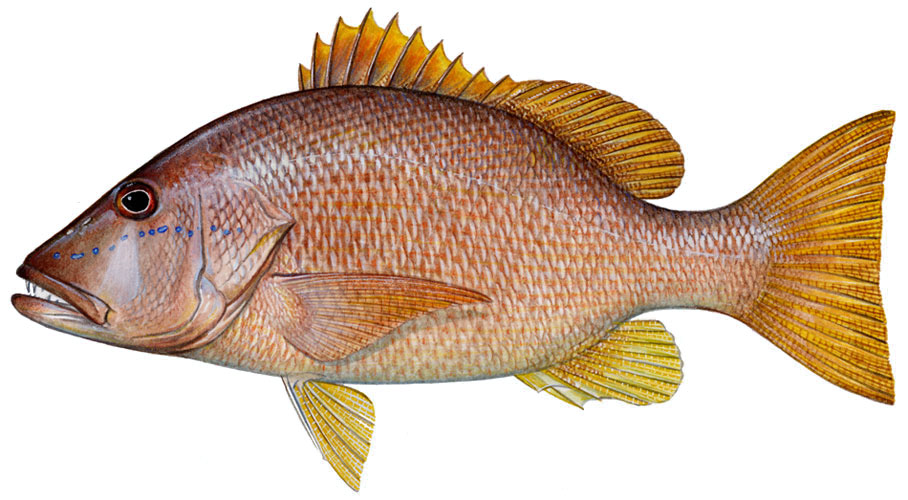
Red Snapper


Family Lutjanidae, SNAPPERS Lutjanus campechanus

Description: color pinkish red over entire body, whitish below; long triangular snout; anal fin sharply pointed; no dark lateral spot.

Similar Fish: vermilion snapper, R. aurorubens.

Where found: OFFSHORE on the continental shelf, more plentiful off the panhandle than in south or middle Florida.

Size: to 20 pounds.


*Florida Record: 46 lbs., 8 ozs.

Remarks: juveniles occur over sandy or mud bottoms and are often taken in shrimp trawls; adults may live more than 20 years, and attain 35 pounds or more; sexual maturity attained at age 2; spawns June to October; feeds on crustaceans and fish.

* The Florida records quoted are from the Department of Environmental Protection's printed publication, Fishing Lines and are not necessarily the most current ones. The records are provided as only as a benchmark.

Queen Snapper


Family Lutjanidae, SNAPPERS Etelis oculatus

Description: color of back and upper sides red; silvery body long and slender; dorsal fin distinctly notched; large eyes; caudal fin deeply forked; no dark lateral spot.

Similar Fish: other snappers.

Where found: OFFSHORE over rocky reefs of the continental shelf to 450 feet; young suspend at mid-depths.

Size: small species, usually less than 20 inches.


*Florida Record: n/a

Remarks: little is known, but it is reported that adults live at depths greater than 400 feet.

* The Florida records quoted are from the Department of Environmental Protection's printed publication, Fishing Lines and are not necessarily the most current ones. The records are provided as only as a benchmark.

Mutton Snapper


Family Lutjanidae, SNAPPERS Lutjanus analis

Description: color olive green on back and upper sides, all fins below the lateral line having reddish tinge; bright blue line below eye, following contour of operculum; anal fin pointed; small black spot below dorsal fin; V-shaped tooth patch on

Similar Fish: lane snapper, L. synagris (anal fin pointed in mutton snapper, rounded in lane).

Where found: an INSHORE species associated with grassbeds, mangroves, and canals; larger adults occasionally found on OFFSHORE reefs.

Size: common to 15 pounds.


*Florida Record: 27 lbs., 6 ozs.

Remarks: spawns in July and August; feeds on fish, crustaceans, and snails.

* The Florida records quoted are from the Department of Environmental Protection's printed publication, Fishing Lines and are not necessarily the most current ones. The records are provided as only as a benchmark.

Mahogany Snapper


Family Lutjanidae, SNAPPERS Lutjanus mahogoni

Description: color graysh-olive with a reddish tinge; conspicuous dark spot, about the size of the eye, below the soft dorsal fin, 1/4 to 1/2 of it below the lateral line; the large eye and caudal fin are bright red; lower margin of the preopercle has prominent spur with strong and sharp serrations.

Similar Fish: lane snapper, L. synagris (also with dark spot below soft dorsal, the blotch placed higher in relation to the lateral line).

Where found: NEARSHORE or OFFSHORE in clear, highly saline water, usually over reefs.

Size: relatively small snapper, common to 15 inches.


*Florida Record: n/a

Remarks: the Spanish name, ojanco, refers to its large eyes; a night feeder, with diet of smaller fishes.

* The Florida records quoted are from the Department of Environmental Protection's printed publication, Fishing Lines and are not necessarily the most current ones. The records are provided as only as a benchmark.

Lane Snapper


Family Lutjanidae, SNAPPERS Lutjanus synagris

Description: color silvery-pink to reddish with short, irregular pink and yellow lines on its sides; diffuse black spot, about as large as the eye; the dorsal fin centered above the lateral line; outer margin of caudal fin blackish.

Similar Fish: mutton snapper, L. analis (anal fin rounded in lane snapper, pointed in mutton).

Where found: juveniles INSHORE over grass beds or shallow reefs; adults OFFSHORE; most common in south Florida.

Size: usually less than 1 pound.


*Florida Record: 6 lbs., 6 ozs.

Remarks: spawns March through September; sexually mature at 6 inches; feeds on bottom, taking crustaceans, mollusks, and fish.

* The Florida records quoted are from the Department of Environmental Protection's printed publication, Fishing Lines and are not necessarily the most current ones. The records are provided as only as a benchmark.

Mangrove Snapper


Family Lutjanidae, SNAPPERS Lutjanus griseus

Description: color dark brown or gray with reddish or orange spots in rows along the sides; dark horizontal band from snout through eye (young only); two conspicuous canine teeth at front of upper jaw; dorsal fins have dark or reddish borders; no dark spot on side underneath dorsal fin.

Similar Fish: cubera snapper, L. cyanopterus.

Where found: juveniles INSHORE in tidal creeks, mangroves, and grass beds; adults generally NEARSHORE or OFFSHORE on coral or rocky reefs.

Size: offshore catches common 8 to 10 pounds.


*Florida Record: 16 lbs., 8 ozs.

Remarks: spawns June through August; feeds on crustaceans and small fish.

* The Florida records quoted are from the Department of Environmental Protection's printed publication, Fishing Lines and are not necessarily the most current ones. The records are provided as only as a benchmark.

Dog Snapper


Family Lutjanidae, SNAPPERS Lutjanus jocu

Description: color brown with a bronze tinge, lighter on sides; canine teeth very sharp, one pair notably enlarged, visible even when mouth is closed; in adults, pale triangle and a light blue interrupted line below the eye; no dark spot on body underneath dorsal fin.

Similar Fish: schoolmaster, L. apodus (no white triangle under eye and fins are more yellow); other snappers.

Where found: large adults OFFSHORE over coral and rocky reefs; juveniles associated with estuaries.

Size: large snapper, attaining 30 pounds.


*Florida Record: n/a

Remarks: spawns from spring through fall; known as night feeder; taking fishes, mollusks, and crustaceans.

* The Florida records quoted are from the Department of Environmental Protection's printed publication, Fishing Lines and are not necessarily the most current ones. The records are provided as only as a benchmark.

Cubera Snapper


Family Lutjanidae, SNAPPERS Lutjanus cyanopterus

Description: color dark brown or gray, may have a reddish tinge; broad-based triangular tooth patch on roof of mouth with a posterior extension; despite its specific name, which translates to "blue-fin," the fins have only a slight tinge of blue; canine teeth in both jaws very strong; one pair of canines enlarged and visible even when mouth is closed.

Similar Fish: gray snapper.

Where found: juveniles INSHORE in grass beds; adults OFFSHORE or NEARSHORE over wrecks, reefs, and ledges.

Size: common to 40 pounds.


*Florida Record: 116 lbs.

Remarks: the largest of the snappers, ranging to 125 pounds; not common anywhere in its range; feeds on fishes and larger crustaceans; in the Keys, spawns during later summer.

* The Florida records quoted are from the Department of Environmental Protection's printed publication, Fishing Lines and are not necessarily the most current ones. The records are provided as only as a benchmark.

Blackfin Snapper


Family Lutjanidae, SNAPPERS Lutjanus buccanella

Description: color generally red, with yellowish caudal, anal, and pelvic fins; distinctive and prominent dark comma-shaped blotch at the base of the pectoral fins, which gives the fish its common name; anal fin rounded; no black spot on side underneath dorsal fin.

Similar Fish: other snappers.

Where found: adults OFFSHORE near continental shelf.

Size: common to 20 inches, larger adults seeking deeper waters.


*Florida Record: n/a

Remarks: sometimes marketed as red snapper; feeds on smaller fishes.

* The Florida records quoted are from the Department of Environmental Protection's printed publication, Fishing Lines and are not necessarily the most current ones. The records are provided as only as a benchmark.


Shortfin Mako


Family Lamnidae, MACKEREL SHARKS Isurus oxyrinchus

Description: lunate tail with similarily sized lobes; lateral keel at the base of the tail; deep blue back and white underside; underside of sharply pointed snout white; origin of first dorsal entirely behind base of pectoral fins; second dorsal fin slightly in front of anal fin; slender, recurved teeth with smooth edge.
Similar Fish: white shark, Carcharoden carcharias; longfin mako, Isurus paucus.
Where found: OFFSHORE fish often seen near the surface.
Size: commonly 6 to 8 feet (200 to 300 pounds).
*Florida Record: 911 lbs, 12 ozs.
Remarks: active, strong swimming fish known for leaping out of the water when hooked; feeds on mackerel, tuna, sardines, and some much larger fish.
* The Florida records quoted are from the Department of Environmental Protection's printed publication, Fishing Lines and are not necessarily the most current ones. The records are provided as only as a benchmark.

Scalloped Hammerhead


Family Sphyrnidae, HAMMERHEAD SHARKS Sphyrna tiburo

Description: fifth gill slit shorter than 4 preceeding ones and located posterior to pectoral fin base; flattened head extending to hammer-like lobes on each side; distinct indentation of the front margin of the head at its midpoint; second dorsal fin longer than tail; gray-brown to olive in color with white underbelly; teeth smooth-edged; pectoral fins tipped with black on the undersurface; tips of first and second dorsal lobes and caudal also may have dusky tips; pelvic fin with nearly straight hind margin.

Similar Fish: other hammerhead sharks.

Where found: both OFFSHORE and INSHORE.

Size: common to 6 feet and can reach 14 feet.


*Florida Record: n/a

Remarks: predatory fish, feeding mainly on fish, squid, and stingrays; male matures at about 6 feet in length.

* The Florida records quoted are from the Department of Environmental Protection's printed publication, Fishing Lines and are not necessarily the most current ones. The records are provided as only as a benchmark.