skip to main |
skip to sidebar
 Family Lutjanidae, SNAPPERS Etelis oculatus
Description: color of back and upper sides red; silvery body long and slender; dorsal fin distinctly notched; large eyes; caudal fin deeply forked; no dark lateral spot.
Similar Fish: other snappers.
Where found: OFFSHORE over rocky reefs of the continental shelf to 450 feet; young suspend at mid-depths.
Size: small species, usually less than 20 inches.
*Florida Record: n/a
Remarks: little is known, but it is reported that adults live at depths greater than 400 feet.
* The Florida records quoted are from the Department of Environmental Protection's printed publication, Fishing Lines and are not necessarily the most current ones. The records are provided as only as a benchmark.
 Family Lutjanidae, SNAPPERS Lutjanus griseus
Description: color dark brown or gray with reddish or orange spots in rows along the sides; dark horizontal band from snout through eye (young only); two conspicuous canine teeth at front of upper jaw; dorsal fins have dark or reddish borders; no dark spot on side underneath dorsal fin.
Similar Fish: cubera snapper, L. cyanopterus.
Where found: juveniles INSHORE in tidal creeks, mangroves, and grass beds; adults generally NEARSHORE or OFFSHORE on coral or rocky reefs.
Size: offshore catches common 8 to 10 pounds.
*Florida Record: 16 lbs., 8 ozs.
Remarks: spawns June through August; feeds on crustaceans and small fish.
* The Florida records quoted are from the Department of Environmental Protection's printed publication, Fishing Lines and are not necessarily the most current ones. The records are provided as only as a benchmark.
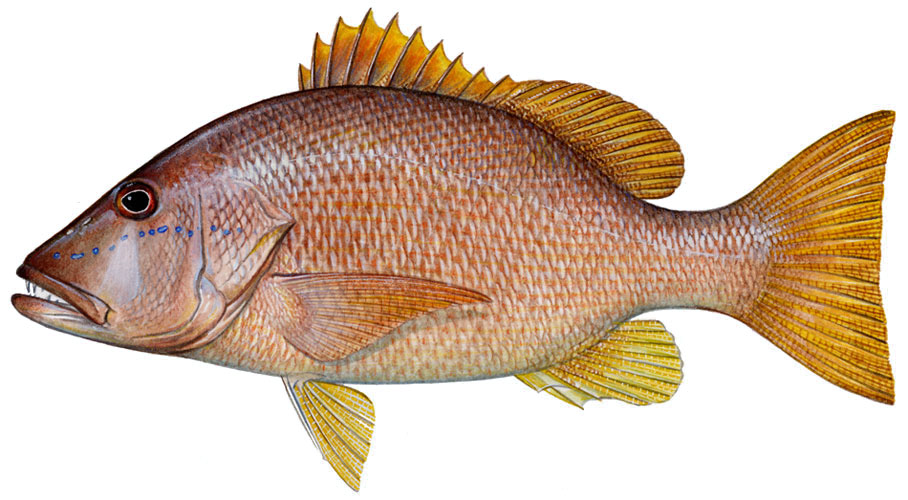
 Family Lutjanidae, SNAPPERS Lutjanus jocu
Description: color brown with a bronze tinge, lighter on sides; canine teeth very sharp, one pair notably enlarged, visible even when mouth is closed; in adults, pale triangle and a light blue interrupted line below the eye; no dark spot on body underneath dorsal fin.
Similar Fish: schoolmaster, L. apodus (no white triangle under eye and fins are more yellow); other snappers.
Where found: large adults OFFSHORE over coral and rocky reefs; juveniles associated with estuaries.
Size: large snapper, attaining 30 pounds.
*Florida Record: n/a
Remarks: spawns from spring through fall; known as night feeder; taking fishes, mollusks, and crustaceans.
* The Florida records quoted are from the Department of Environmental Protection's printed publication, Fishing Lines and are not necessarily the most current ones. The records are provided as only as a benchmark.
 Family Serranidae, SEA BASSES AND GROUPER Centropristis ocyurus
Description: pale olive or brassy brown in color with indistinct black blotches that form vertical barrings (the blotch above pectoral fin darker); wavy blue lines on head; lips purplish-blue; caudal fin tri-lobed on adults; edge of nape unscaled.
Similar Fish: rock sea bass C. philadelphica; other Centropristis.
Where found: OFFSHORE in deep water with rocks and reefs.
Size: usually 0.3 pound (8 inches).
*Florida Record: n/a
Remarks: undergoes sex change, starting life as female, changing to male after three or four spawning seasons; feeds on the bottom, taking squid, crustaceans, and small fish.
* The Florida records quoted are from the Department of Environmental Protection's printed publication, Fishing Lines and are not necessarily the most current ones. The records are provided as only as a benchmark.
 Family Carangidae, JACKS and POMPANOS Seriola dumerili
Description: dark stripe (variably present) extends from nose to in front of dorsal fin and "lights up" when fish is in feeding mode; no scutes; soft dorsal base less than twice the length of the anal fin base.
Similar Fish: other Seriola.
Where found: OFFSHORE species associated with rocky reefs, debris, and wrecks, typically in 60 - 240 feet of water; sometimes caught NEARSHORE in south Florida; juveniles associated with floating objects and may occur in water less than 30 feet deep.
Size: common to 40 pounds.
*Florida Record: 142 lbs.
Remarks: largest of the jacks; thought to spawn OFFSHORE throughout most of the year; feeds on squid, fish, and crustaceans.
* The Florida records quoted are from the Department of Environmental Protection's printed publication, Fishing Lines and are not necessarily the most current ones. The records are provided as only as a benchmark.
 Family Serranidae, SEA BASSES AND GROUPER Mycteroperca interstitialis
Description: color tan or brown with darker spots, or a network of spots, fused into lines; distinct yellow wash behind the jaws; yellow around the eyes; outer edges of fins yellowish.
Similar Fish: scamp, M. phenax.
Where found: OFFSHORE over reefs and rocks; not as common as scamp in the Gulf; range limited to southern Florida.
Size: common to 15 pounds.
*Florida Record: 28 lbs.
Remarks: undergoes sex reversal, young individuals female, older individuals becoming male; young fish are bicolored, dark above white below; feeds on small fsh and crustaceans.
* The Florida records quoted are from the Department of Environmental Protection's printed publication, Fishing Lines and are not necessarily the most current ones. The records are provided as only as a benchmark.
 Family Serranidae, SEA BASSES AND GROUPER Epinephelus striatus
Description: color light background with brown or red-brown bars on sides; stripe in shape of tuning fork on forehead; third spine of dorsal longer than second ; pelvic fins shorter than pectorals; black dots around the eyes; large black saddle on caudal peduncle.
Similar Fish: red grouper, E. morio.
Where found: range limited to south Florida; somewhat site specific; smaller individuals NEARSHORE, adults OFFSHORE on rocky reefs.
Size: most catches under 10 pounds.
*Florida Record: n/a
Remarks: forms large spawning aggregations, making this species highly vulnerable to overharvest. NOTE: all harvest of this species is prohibited.
* The Florida records quoted are from the Department of Environmental Protection's printed publication, Fishing Lines and are not necessarily the most current ones. The records are provided as only as a benchmark.
 Family Serranidae, SEA BASSES AND GROUPER Mycteroperca microlepis
Description: brownish gray in color with dark worm-like markings on sides; strong serrated spur at bottom margin of preopercle, less noticeable in large specimens; fins dark, with anal and caudal having white margin. Often confused with black grouper; tail of gag is slightly concave, black is square; gag has white margin on anal and caudal fins, black does not; under 10 pounds, gag's spur on preopercle is distinctive, where black is gently rounded.
Similar Fish: black grouper M. bonaci.
Where found: adults OFFSHORE over rocks and reefs; juveniles occur in seagrass beds INSHORE.
Size: common to 25 pounds.
*Florida Record: 71 lbs., 3 ozs.
Remarks: forms spawning aggregations in water no shallower than 120 feet in Middle Grounds area, January through March; current reseach to identify similar aggregations off Atlantic coast is ongoing. Young gags are predominantly female, transforming into males as they grow larger; feeds on fish and squid.
* The Florida records quoted are from the Department of Environmental Protection's printed publication, Fishing Lines and are not necessarily the most current ones. The records are provided as only as a benchmark.
 Family Serranidae, SEA BASSES AND GROUPER Mycteroperca bonaci
Description: olive or gray body coloration with black blotches and brassy spots; gently rounded preopercle.
Similar Fish: gag M. microlepis; yellowfin grouper, M. venenosa.
Where found: OFFSHORE species; adults associated with rocky bottoms, reef, and drop off walls in water over 60 feet deep; young may occur INSHORE in shallow water.
Size: common to 40 pounds, may attain weights exceeding 100 pounds.
*Florida Record: no Florida record because of identity confusion with gag, which are mistakenly called "black grouper."
Remarks: spawns between May and August; protogynous hermaphrodites, young predominantly female, transforming into males as they grow larger; larger individuals generally in greater depths; feeds on fish and squid.
* The Florida records quoted are from the Department of Environmental Protection's printed publication, Fishing Lines and are not necessarily the most current ones. The records are provided as only as a benchmark.
 Family Bothidae, LEFTEYE FLOUNDERS Paralichthys albigutta
Description: body color brown, its shade depending on color of bottom, with numerous spots and blotches; 3 prominent eye-like spots forming a triangle; one spot on lateral line, one above, one below; numerous white spots scattered over body and fins (albigutta, white-spotted); strong canine-like teeth; caudal fin in shape of wedge, its tip in the middle.
Similar Fish: southern flounder, P. lethostigma (no eye-like spots; color pattern is key to distinguishing the two species).
Where found: INSHORE on sandy or mud bottoms, often ranging into tidal creeks; occasionally caught on NEARSHORE rocky reefs.
Size: common to 2 pounds, generally smaller than southern flounder.
*Florida Record: n/a
Remarks: hatches into usual fish form, but right eye migrates over to left side early in life; a bottom dweller; thought to spawn OFFSHORE; feeds on crustaceans and small fishes.
* The Florida records quoted are from the Department of Environmental Protection's printed publication, Fishing Lines and are not necessarily the most current ones. The records are provided as only as a benchmark.