Saturday, May 22, 2010

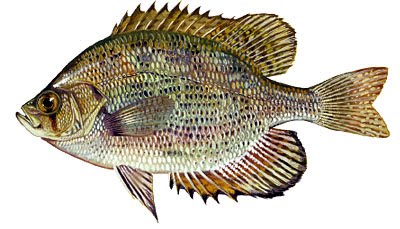
Warmouth

Warmouth (Lepomis gulosus)

Common Names - warmouth bass, warmouth perch, goggle-eye, redeye and goggle-eyed perch.

Description - The warmouth closely resembles a bass or a bream. It has a stout, deep body similar to that of a bluegill or redear sunfish, yet has a large bass-like mouth. The red eye and large mouth are the first conspicuous field marks of mature warmouth. They vary from brassy to dark-olive green and often have a purple tint overall. Broad, irregular dark bars give it a mottled appearance. The soft-rayed portions of the dorsal and anal fins are marked with rows of dark spots. Three or four conspicuous dark stripes radiate back from the eye across to the cheek and gill cover.

Subspecies - There are no recognized subspecies. However, warmouths readily hybridize with other members of the sunfish family.

Range - Found throughout Florida.

Habitat - Warmouths inhabit swamps, marshes, shallow lakes, slow-moving streams and canals with soft, muddy bottoms. They prefer to stay around aquatic vegetation, stumps, and snags and under the banks of streams and ponds. They have more tolerance for muddy water than most species.

Spawning Habits - Warmouths are solitary nesters that prefer to build their nest adjacent to some submerged object. Nests are found over a wide range of water depths. They often spawn more than once a year usually between April and August. Females may produce 3,000 to 23,000 eggs.

Feeding Habits - Warmouths are carnivorous. Crayfish, shrimp, insects and small fishes make up the bulk of its diet. Most of its feeding is done in the morning, as it seems to sleep at night.

Age and Growth - Warmouths are capable of living up to eight years and may reach a length of 12 inches and a weight of approximately one pound.

Sporting Qualities - The warmouth is one of the more easily caught sunfish by anglers using cane poles and natural baits, spinning tackle with small topwater lures and shallow-running spinners. They strike hard, frequently breaking the surface of the water. The best place to catch warmouths is shallow water around trees, stumps, or vegetation. As a sport fish, specific bag and size limit
regulations apply, and you can register a qualifying catch as part of the Florida Fish and Wildlife Conservation Commission's "Big Catch" program.

Eating Quality - The warmouth are good to eat when caught from clean water. Like other panfish they are relatively small and bony. The flesh is usually prepared by deep-frying after rolling it in seasoned cornmeal

State and World Records - 2 pounds, 7 ounces, caught in Guess Lake (Yellow River), Florida, in 1985

Redbreast Sunfish

Redbreast Sunfish(Lepomis auritus)

Common Names - redbelly, robin, yellowbelly sunfish, bream, river bream, longear sunfish, sun perch and redbreast bream.

Description - The redbreast is one of the brightest colored sunfishes. Males have yellow, orange or red breast, olive upper sides, blending into blue-tinged bronze on the lower sides and blue streaks on the cheek. Females are less colorful; their breasts are yellowish or pale red. The most distinguishing characteristic of this species is a long, narrow (no wider than the eye) extension of the gill cover. These flaps, which may reach a length of one inch or more, are entirely black.

Subspecies - There are no recognized subspecies. They are known to hybridize with other members of the sunfish family.

Range - The redbreast is found throughout central and northern Florida. It is the most dominant sunfish in such streams as the Oklawaha, Ochlockonee, Suwannee, and Santa Fe rivers. This species has been introduced into the Blackwater and Yellow rivers in northwestern Florida. They are also common in some lakes such as the Harris Chain and Starke Lake in Ocoee.

Habitat - Redbreasts inhabit sand-bottom areas as well as rocky areas of coastal-plain streams, rivers, and lakes. They frequently concentrate around boulders, limestone outcroppings, logs, aquatic vegetation, or in undercut tree roots.

Spawning Habits - They reproduce in typical sunfish fashion by constructing circular beds; but not clustered like bluegills, in water from one to three feet deep usually adjacent underwater objects such as stumps and snags. They often occupy beds that have been abandoned by other sunfishes. Spawning occurs from May through August when water temperatures range from 68 to 82 degrees. Males are the nest builders and guard the eggs and larvae for a short period after hatching. The number of eggs laid in a season ranges from about 1,000 to 10,000, varying with the age and size of the female.

Feeding Habits - The redbreast's diet is probably the most varied of any of the sunfishes. Principal food organisms are bottom-dwelling insect larvae, snails, clams, shrimp, crayfish, and small fish.

Age and Growth - Compared to some sunfish, redbreasts grow slowly. Redbreast reach six-inches in about two to three years. They seldom live beyond seven years and commonly reach a length of eight inches.

Sporting Qualities - Redbreasts are prized game fish and are caught on natural baits and artificial lures. They a good fighters and will bite on flies and small spinners, as well as worms, crickets, grasshoppers and small minnows. Unlike most sunfishes, redbreasts bite well at night. Fishing from a drifting or slowly powered boat is the best way to catch redbreasts, although angling from the bank can be productive. As a sport fish, specific bag and size limit
regulations apply, and you can register a qualifying catch as part of the Florida Fish and Wildlife Conservation Commission's "Big Catch" program.

Eating Quality - The sweet, flaky, white flesh is excellent eating. They are most often fried after dipping them in seasoned cornmeal or pancake batter.

World Record - 1 pound, 12 ounces, caught in the Suwannee River, Florida, in 1984.
State Record - 2 pounds, 1.25 ounces, caught in the Suwannee River, in 1988

Flier

Flier(Centrarchus macropterus)

Common Names - round sunfish and millpond flier.

Description - The flier is a small sunfish that has a strongly compressed, deep, round body and small mouth. The coloration is greenish or silver green to brown on back and sides with a cream or yellowish belly with a brown dot on each scale giving the appearance of numerous rows of dots. Young fish have a large black spot surrounded by bright orange in the soft rays of the dorsal fin. A dark vertical streak is present below the eye and extends to the lower edge of the operculum.
The dorsal and anal fins are nearly symmetrical.

Subspecies - There are no recognized subspecies. Has been known to hybridize with other sunfish.

Range - Fliers range from the northern part of the state southward to central Florida.

Habitat - They inhabit dark, acidic waters of coastal swamps, creeks, ponds, and canals. They prefer heavily vegetated water and are often found under mats of floating vegetation. Fliers can tolerate waters too acidic for other sunfish. They prefer water temperatures from 75 to 85 degrees.

Spawning Habits - Spawning begins in March when water temperatures reach 62 to 68 degrees. The male prepares a nest and the female lays from 5,000 to 50,000 eggs. Nesting may be solitary or in small colonies. Males continuously guard the eggs and recently hatched young.

Feeding Habits - Fliers are carnivorous in their feeding habits. They prefer insects, crustaceans, mollusks, worms, leeches, and small fish are supplemented with small quantities of phytoplankton.

Age and Growth - Fliers live as long as eight years but grow very slowly. They may attain a maximum length of about 10 inches and a weight of one pound, however most are much smaller. There is no apparent difference in size or rate of growth between males and females.

Sporting Qualities - Although fliers fight well for their size, they are often too small to generate much interest among anglers. Fliers can be caught on dry flies, tiny poppers, worms, insect larvae and small minnows. Good fishing locations are around cypress trees and stumps, near brush piles, and at the mouths of small creeks and canals. As a sport fish, specific bag and size limit
regulations apply, and you can register a qualifying catch as part of the Florida Fish and Wildlife Conservation Commission's "Big Catch" program.

Eating Qualities - The flesh is sweet and excellent to eat. The same methods of cooking other sunfish apply for fliers

World Record - None

State record - 1 pound, 1 ounce, caught in Lake Iamonia, in 1985

Friday, May 21, 2010

Warsaw Grouper

Family Serranidae

Description: uniformly dark brown, with no distinctive markings; dorsal fin with 10 spines; second spine very long (much longer than third); caudal fin squared-off; rear nostril larger than front nostril

Young: caudal fin yellow; dark saddle on caudal peduncle; some whitish spots on body

Size: to 1.8 meters (6 feet) and 263 kilograms (580 pounds)

Habitat: deep rocks ledges and sea mounts in 90-300 meters (300-1000 feet); young are sometimes caught in inshore waters

Thursday, May 20, 2010

Striped Mojarra

Family Gerreidae

Description: body dark olive above; tan to silvery on side, often with a metallic sheen; conspicuous blackish stripe along center of each scale row, except toward belly; all fins except pectoral fins dusky in large adults; and anal fins sometimes dark orange; pelvic spine and first 2 anal spines pale; dorsal and anal spines long and stout; 3 anal spines

Size: to 30 centimeters (1 foot)

Where found: brackish and coastal fresh waters (in limestone regions), grassy areas


Tripletail

Family Lobotidae

Description: head and body variously mottled, tan to dark brown; fins (except spinous dorsal and pectoral fins) almost black; pale olive band across base of caudal fin; broad, dark brown bar from eye across cheek below corner of preopercle, and another from upper corner of eye to beginning of dorsal fin; two dark streaks on top of head, behind nostrils; upper profile concave at nape; edge of preopercle strongly serrated

Size: to 1.1 meters (42 inches)

Lookdown

Family Carangidae

Description: silvery, iridescent, sometimes with brassy highlights; body extremely compressed and deep, platelike; front of head very steep; lobes at front of soft dorsal and anal fins very long; pelvic fins small; lateral line arched toward front

Young: spines at front of dorsal fin and rays in pelvic fin streamerlile

Size: to 30 centimeters (1 foot)

Horse Eye Jack

Family Carangidae

Description: similar in shape to the Crevalle jack, but front of head less steep; blackish blotch at edge of opercle small, poorly defined, or absent; no dark blotch on pectoral fin; entire chest scaly except in individuals less than 77 millimeters (3 inches) long; scutes usually blackish; caudal fin yellowish; 20 to 22 soft rays in dorsal fin; 14 to 18 gill rakers on lower limb of first arch

Size: to 75 centimeters (30 inches) and 3.8 kilograms (8.5 pounds)

Yellowfin Tuna

Family Scombridae

Description: pectoral fin moderately long, reaching point below beginning of second dorsal fin; second dorsal fin and all finlets yellow; no white rear edge on caudal fin; golden stripe on side; second dorsal and anal fins become much longer with age (to about 1/5 of total length); eye small; 26 to 35 gill rakers

Size: to 2.1 meters (82 inches) and 176 kilograms (367 pounds)

Where found: offshore mostly bluewater; in or near the Gulfstream

Wahoo

Family Scombridae

Description: body slender; elongate jaws form a pointed beak; dark bluish above, with about 30 dark bars; whitish below first dorsal fin long and low, with 21 to 27 spines; no gill rakes

Size: to 2.1 meters (83 inches) and 83 kilograms (183 pounds)

Where found: offshore Gulfstream; bluewater

Remarks: an important game fish, renowned for its tremendous runs and shifts of direction; usually not in schools; caught by trolling bait and artificial lures on flatlines

Little Tunny

Family Scombridae

Territory: Common offshore

Size: 20-25 lbs but usually caught 5-10 lbs

Remarks: An excellent baitfish for marlin and other large game fish, poor table fare

Great Barracuda

Family Sphyraenidae

Description: gray, with a greenish cast above, whitish below; many irregular, small black blotches on lower side; 18 to 22 diagonal dark bars on upper side (not always evident); caudal fin dark with white tips; 75 to 87 lateral line scales; no fleshy tip on jaw

Young: dark stripe on side; stripe breaks into dark squarish blotches as fish grows

Size: to 2 meters (6 feet) and 48 kilograms (106 pounds); reports of larger fish unverified

Where found: young live in inshore seagrass beds; adults range from inshore channels to open ocean

Remarks: most attacks on people have occurred when they were wading or swimming in turbid water while wearing bright objects, attempting to spear a barracuda, or carrying speared fish; flesh of smaller fish apparently not poisonous, but larger fish sometimes very toxic due to ciguatera; no safe, reliable way of recognizing toxic fish


Blackfin Tuna


Family Scombridae
Description: pectoral fin moderately long, reaching point below beginning of second dorsal fin; second dorsal fin dusky; all finlets dusky, with white edges; dorsal finlets sometimes turn yellowish at base after death; a broad, brownish stripe along upper part of side; eye large; 19 to 25 gill rakers (usually 21 to 23) on first arch
Size: to 1 meter (3.25 feet) and 19 kilograms (42 pounds)
Where found: near shore and offshore

Sand Perch


Family Serranidae

Description: body and dorsal fins with many dark brown bars and alternating orange and blue horizontal lines; head with many blue lines; preopercular spines very well developed; grouped in 2 radiating clusters with a deep notch between them; upper lobe of caudal fin prolonged in adults
Size: to 30 centimeters (1 foot)
Where found: bays, coastal grassy areas, and shallow banks
Remarks: popular as a pan fish despite its small size

Red Porgy


Family Sparidae

Description: the only American porgy with a rear nostril that is round (not slit-like); head and body silvery red, with many tiny blue spots
Size: to 91 centimeters (3 feet)
Where found: deeper part of continental shelf, but young occur in water as shallow as 18 meters (60 feet)

Knobbed Porgy

Family Sparidae

Description: body deep; front profile very steep; nape projects strongly in large adults; body generally silvery, with a rosy cast; cheek and snout dark purplish gray, with many bronze spots; large blut spot at axil of pectoral fin

Size: to 46 centimeters

Where found: hardbottom, reefs, ledges

Jolthead Porgy

Family Sparidae

Description: generally silvery to brassy, with a bluish cast; front of head brown, with blue line along lower rim of eye; a whitish stripe below eye, and another between eye and mouth; corner of mouth orange

Size: to 60 centimeters (2 feet) and 3.6 kilograms (8 pounds)

Where found: coastal waters to 45 meters (150 feet)


Hogfish


Family Labridae

Description: body deep, strongly compressed; color varies, but never bicolored; usually reddish, sometimes bright brick red; soft dorsal fin with a large dark spot at base; entire top of head nape purplish brown in lare males; this patch of color continuous with blackish area that extends along entire base of dorsal fin; large blackish crescent through base of caudal fin; pelvic fin with dusky tip; 14 spines in dorsal fin - first 3 elongate, bladelike; rays at front of soft dorsal and anal fins and lower lobes of caudal fin elongate; mouth very protrusible

Young: greenish or brownish, mottled with dark

Size: to 91 centimeters (3 feet)

Remarks: esteemed as a food fish in some areas, but has been implicated in ciguatera; usually marketed as Hog Snapper

Gray Triggerfish

Family Balistidae

Description: entirely olive-gray; dorsal and anal fins marbled; caudal fin lobes elongate in large adults; one or more enlarged scales behind gill opening; 26 to 29 dorsal fin rays; 23 to 26 anal fin rays

Young: large darker saddles on back (these saddles sometimes persit in adults); blue spots and short blue lines in dorsal fin and on upper half of body, becoming white below and in anal fin; upper rim of eye blue

Where found: hardbottom, reefs, ledges

Grass Porgy

Family Sparidae

Description: pale tan to silvery; dark olive above; dark bar across nape extends through eye to corner of mouth; dark blotches on body, in about 5 vertical and 4 horizontal series, suggesting interrupted bars and stripes; blotch near front of lateral line most proiminent; dark V at base of caudal fin; lobes of caudal fin with dark bars

Size: to 25 centimeters (10 inches)

Where found: inshore seagrass beds