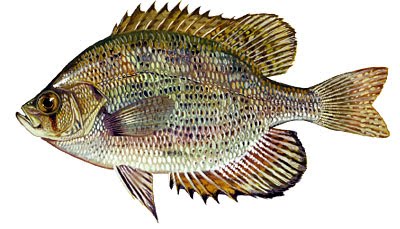
 Flier(Centrarchus macropterus)
Common Names - round sunfish and millpond flier.
Description - The flier is a small sunfish that has a strongly compressed, deep, round body and small mouth. The coloration is greenish or silver green to brown on back and sides with a cream or yellowish belly with a brown dot on each scale giving the appearance of numerous rows of dots. Young fish have a large black spot surrounded by bright orange in the soft rays of the dorsal fin. A dark vertical streak is present below the eye and extends to the lower edge of the operculum.
The dorsal and anal fins are nearly symmetrical.
Subspecies - There are no recognized subspecies. Has been known to hybridize with other sunfish.
Range - Fliers range from the northern part of the state southward to central Florida.
Habitat - They inhabit dark, acidic waters of coastal swamps, creeks, ponds, and canals. They prefer heavily vegetated water and are often found under mats of floating vegetation. Fliers can tolerate waters too acidic for other sunfish. They prefer water temperatures from 75 to 85 degrees.
Spawning Habits - Spawning begins in March when water temperatures reach 62 to 68 degrees. The male prepares a nest and the female lays from 5,000 to 50,000 eggs. Nesting may be solitary or in small colonies. Males continuously guard the eggs and recently hatched young.
Feeding Habits - Fliers are carnivorous in their feeding habits. They prefer insects, crustaceans, mollusks, worms, leeches, and small fish are supplemented with small quantities of phytoplankton.
Age and Growth - Fliers live as long as eight years but grow very slowly. They may attain a maximum length of about 10 inches and a weight of one pound, however most are much smaller. There is no apparent difference in size or rate of growth between males and females.
Sporting Qualities - Although fliers fight well for their size, they are often too small to generate much interest among anglers. Fliers can be caught on dry flies, tiny poppers, worms, insect larvae and small minnows. Good fishing locations are around cypress trees and stumps, near brush piles, and at the mouths of small creeks and canals. As a sport fish, specific bag and size limit regulations apply, and you can register a qualifying catch as part of the Florida Fish and Wildlife Conservation Commission's "Big Catch" program.
Eating Qualities - The flesh is sweet and excellent to eat. The same methods of cooking other sunfish apply for fliers
World Record - None
State record - 1 pound, 1 ounce, caught in Lake Iamonia, in 1985


